
People can begin forming impressions of competence before you have said a word. Princeton researchers found across nine studies that subtle cues from clothing influenced how competent the same faces appeared, and those judgments could happen after extremely brief exposure.
That does not mean an expensive suit automatically makes someone capable. It does explain why choosing the right formal dress for men colour combination for office settings deserves more thought than simply matching a shirt with pants.
For most American workplaces, the safest strategy is surprisingly simple: build around navy, charcoal, gray, white, and light blue, then introduce restrained secondary colors only after you understand the office culture.
Start With Contrast, Not a List of “Power Colors”
Professional outfits usually look successful because the pieces have a clear visual hierarchy.
A dark navy suit with a white shirt works because the contrast is obvious but controlled. Charcoal trousers with a pale blue shirt create a softer version of the same effect. Beige trousers and an off-white shirt create much less contrast, making them feel more relaxed.
The University of Houston’s Rockwell Career Center recommends navy or gray suits for professional situations and specifically points to pressed dress shirts, simple ties, and coordinated shoes and belt in professional dress guidance.
Think of an office outfit as three layers:
- Choose a neutral foundation: navy, charcoal, medium gray, black, beige, or olive.
- Add a lighter shirt that creates sufficient separation from the trousers or jacket.
- Use shoes, a belt, and possibly a tie to finish the outfit without introducing unnecessary competing colors.
That formula is easier to repeat than memorizing dozens of combinations.
Seven Office Color Combinations That Rarely Miss

| Shirt | Trousers or Suit | Best Use |
| White | Navy | Interviews, presentations, daily corporate wear |
| Light blue | Charcoal gray | Finance, legal, consulting and conservative offices |
| White | Charcoal | Important meetings and formal business settings |
| Light blue | Navy | Everyday polished office wear |
| White | Black | Highly formal workplaces or events |
| Cream | Beige or olive | Business-casual and creative offices |
| Pale pink | Navy or gray | Professional offices with a flexible dress culture |
White Shirt With Navy
This is arguably the most useful professional combination a man can own.
Navy has enough depth to look authoritative without carrying the severity of black. A white shirt introduces clean contrast, while dark brown or black leather shoes can complete the outfit depending on the degree of formality required.
For presentations, interviews, and client meetings, it is difficult to make this combination look inappropriate.
Light Blue With Charcoal Gray
Light blue softens charcoal without making the outfit casual.
Creighton University’s professional dress recommendations specifically identify white and light blue shirts as strong choices for interviews and list charcoal and navy among conservative suit colors.
This pairing works particularly well under artificial office lighting, where a bright white shirt can sometimes create harsher contrast than necessary.
Light Blue With Navy
Wearing two shades from the same color family creates a tonal effect.
The trick is separation. The shirt should be noticeably lighter than the trousers or jacket. Two similar mid-blues can make the outfit appear accidental rather than coordinated.
Dark brown shoes introduce warmth, while black shoes make the outfit more formal.
Cream With Olive or Beige
Cream, stone, taupe, beige, and muted olive work best once the dress code moves away from strict business professional.
They are especially useful in warmer months or offices where employees commonly wear chinos, sport coats, and open-collar dress shirts.
Texas A&M’s Career Center similarly distinguishes business professional from business casual, noting that blazers, collared shirts, khakis, chinos, loafers, and dress shoes can all fit the latter category.
The Safest Suit-and-Shirt Pairings
If your workplace requires suits, reduce experimentation.
Navy Suit + White Shirt
This should be the starting point for most professional wardrobes. Add a burgundy, navy, dark green, or understated patterned tie.
Charcoal Suit + White or Pale Blue Shirt
Charcoal looks slightly more serious than medium gray. It is an excellent choice for important presentations, senior meetings, interviews, and conservative industries.
University of Illinois Dress for Success guide recommends solid, dark, or neutral colors for business-professional clothing, layered with lighter colors.
Black Suit + White Shirt
Black-and-white undoubtedly looks formal, but that does not make it the automatic winner for everyday American office wear.
Black suits can read more ceremonial or severe than navy or charcoal. Unless your workplace is exceptionally formal, navy and charcoal usually offer greater versatility.
Use the Three-Color Test Before Leaving Home
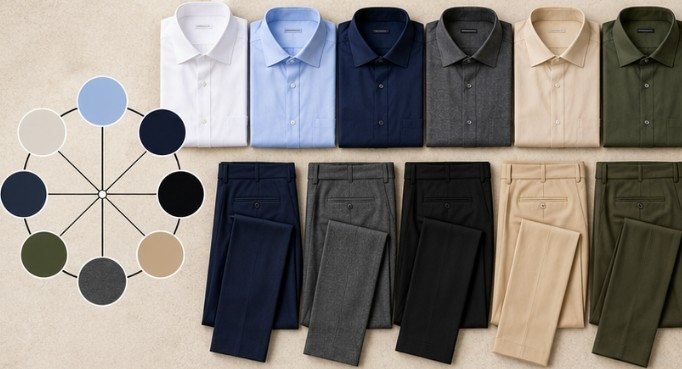
A practical formal dress for men colour combination for office wardrobe becomes much easier if you use a simple three-color test. Stand in front of a mirror and identify the dominant colors visible in your outfit.
If you see navy trousers, a white shirt, brown shoes, and a brown belt, you effectively have three main colors because the leather accessories belong to one family.
Add a red tie and you still have a coherent outfit because the tie is a controlled accent. Add a multicolored patterned jacket, bright socks, contrasting sneakers, and a colorful belt, however, and the eye no longer knows where to settle. Professional clothing generally benefits from restraint.
Princeton’s research provides useful context here on clothing and perceived competence. Participants judged identical faces differently when the clothing associated with those faces appeared to signal different economic status. Importantly, the researchers emphasize that such snap judgments reflect bias rather than actual competence.
Match Shoes and Belts Without Overthinking It
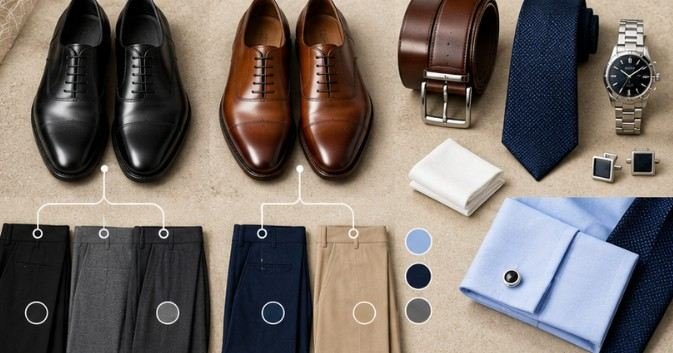
Black leather shoes work naturally with charcoal, dark gray, and black trousers. They also make navy look more formal.
Dark brown shoes are particularly versatile with navy, medium gray, beige, and olive.
Tan leather creates considerably more contrast, making it better suited to business-casual combinations than conservative corporate dress.
Your belt should normally stay within the same color family as your shoes. It does not need to be an identical shade.
And shoe construction matters if you spend significant money on office footwear. Understanding Goodyear welted vs Blake stitch dress shoe durability can help you choose a pair that suits your commuting, resoling, and long-term wear needs.
Pattern Is Where Good Color Combinations Often Go Wrong
A white micro-stripe shirt can work with solid navy trousers. A subtle check can work beneath a plain charcoal suit.
Problems begin when every item demands attention.
If the shirt carries a noticeable pattern, keep the trousers solid. If your suit has visible checks or pinstripes, choose a quieter shirt and tie.
University career guidance commonly emphasizes subtle patterns and limited accessories rather than highly distracting elements. The principle is not that individuality is unprofessional; it is that your clothes should support your presence rather than compete with it.
Your Workplace Still Gets the Final Vote
Dress expectations are not identical across American offices. Banking, legal services, accounting, government-facing roles, and senior client meetings generally reward conservative combinations. Technology, design, media, and startup environments may allow more earth tones, textured jackets, chinos, or open collars.
The U.S. Equal Employment Opportunity Commission also notes that workplace dress policies and accommodations can intersect with legal protections. Employers may establish dress codes, but religious practices and some disability-related needs can require reasonable accommodations.
So do not interpret style conventions as universal rules that override cultural, religious, medical, or employer-specific requirements.
Frequently Asked Questions
1. What is the best formal color combination for men at work?
Navy with white, charcoal with light blue, and gray with white are among the safest combinations because they provide professional contrast without appearing overly decorative.
2. Can I wear brown shoes with navy office trousers?
Yes. Dark brown works especially well with navy and gives the outfit slightly less formality than black footwear while remaining professional.
3. Is black the most professional office color?
Not necessarily. Navy and charcoal are often more versatile for everyday business wear, while black can appear more severe or ceremonial.
4. How many colors should a formal office outfit contain?
Three main color families are usually enough. Keep the jacket or trousers dominant, the shirt lighter, and shoes, belt, or tie coordinated as secondary accents.
A Better Way to Build Your Office Wardrobe
The strongest office wardrobe is rarely the one with the most colors. It is the one in which nearly everything works together.
I would start with navy and charcoal trousers or suits, add several white and light-blue shirts, then choose black and dark-brown leather footwear. Once those pieces cover ordinary workdays, presentations, and interviews, cream, olive, burgundy, pale pink, or subtle patterns can add personality.
That is the real advantage of a disciplined formal dress for men colour combination for office strategy: you spend less time trying to invent an outfit every morning and more time knowing that what you put on already works.