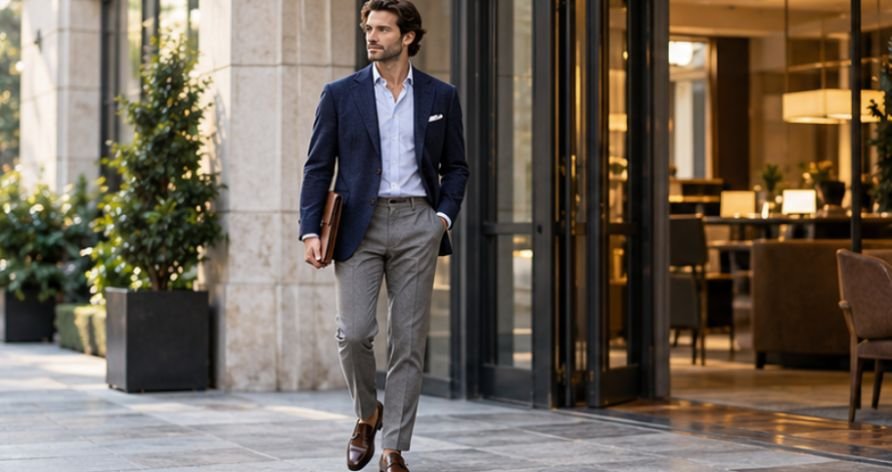
A suit jacket does not automatically become a blazer the moment you leave its matching trousers in the closet. In fact, the wrong jacket worn with chinos can make an otherwise polished outfit look as though half the suit went missing.
So, can you wear a suit jacket as a blazer? Yes—but only certain suit jackets can convincingly stand alone. Texture, sheen, structure, pattern, buttons, and the trousers you pair with it matter far more than the label inside the coat.
The easiest rule is this: the less your jacket looks like it belongs exclusively to a matching suit, the better its chances of working as a separate.
Why a Suit Jacket and Blazer Are Not Quite the Same Thing
Modern menswear sometimes uses “blazer,” “sport coat,” and “suit jacket” loosely, but they serve different wardrobe roles.
A suit jacket is designed as one half of a coordinated outfit. Traditional professional dress still generally calls for matching suit trousers and jacket. The University of Central Missouri’s professional dress guide, for example, defines professional dress around a full matching suit while treating business casual as a more relaxed category.
A blazer or sport coat, by contrast, expects contrasting trousers. It should look complete even when nothing else in the outfit matches its fabric. That distinction explains why some suit jackets transition beautifully while others never look quite right.
The Five-Second Test: Does Your Jacket Look “Orphaned”?

Put on the jacket with a white or light-blue shirt and plain medium-gray trousers. Then stand several feet from a mirror.
Ask yourself three questions:
- Does the jacket appear intentionally different from the trousers?
- Does its fabric have enough texture or visual character to stand independently?
- Would someone assume it was purchased as a separate rather than wonder where the matching pants went?
Three yeses usually mean you can separate it.
Once you have established that a suit jacket works as a standalone piece, check that your trousers complement its proportions and create a balanced silhouette. Understanding how dress pants should fit men can help you assess the waist, seat, leg shape, and hem to achieve a more cohesive appearance.
If the jacket immediately reminds you of corporate interview attire, formal evening wear, or a traditional matching business suit, keep the original trousers with it.
Fabric Is the Biggest Clue
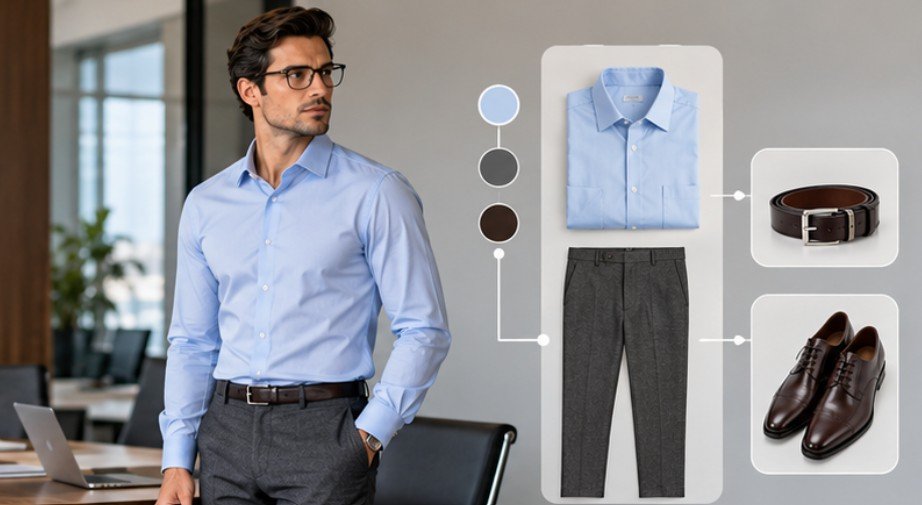
Textured and Matte Jackets Separate Best
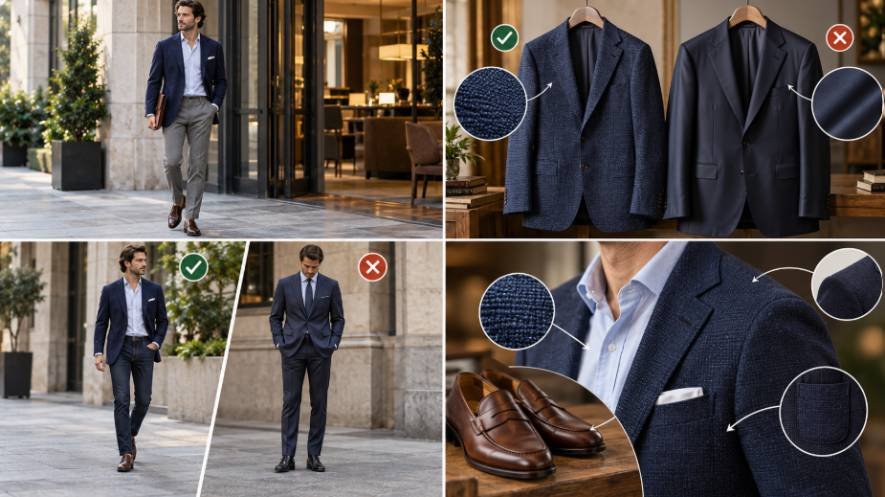
Flannel, tweed, hopsack-style weaves, brushed wool, linen and some cotton suitings have depth. Light hits their irregular surfaces differently, making them resemble fabrics commonly used for standalone jackets.
Wool itself is especially adaptable because of its natural resilience and shape recovery. Those properties help explain its long history in tailored clothing. The Smithsonian’s clothing collections, for example, preserve numerous tailored wool suit collection and tailored jackets as examples of American dress history.
A navy flannel suit jacket with soft shoulders can therefore work surprisingly well with gray trousers or tan chinos.
Smooth Worsted Wool Is Much Harder
Fine worsted wool frequently has a clean, flat finish associated with traditional office suits. The more refined and slightly lustrous it appears, the more obvious its original purpose becomes.
Think of a dark navy investment-banking suit. Removing the matching trousers does not make the jacket casual. It simply makes the suit incomplete.
That is particularly true for super-smooth charcoal, black and midnight-navy jackets.
Structure Can Give the Game Away
A separate jacket usually looks comfortable in a less formal outfit.
Heavy shoulder padding, a rigid chest, substantial lining and sharp architectural tailoring push a jacket toward formal suiting. Pair that with jeans and the upper and lower halves can feel like they belong to completely different dress codes.
A lightly constructed jacket is easier to separate. Soft shoulders, natural drape, moderate lapels and patch or less-formal pockets all help.
This matters in American workplaces because business casual is increasingly treated separately from full professional dress. The University of North Carolina at Charlotte specifically distinguishes matching suit pieces for professional attire from relaxed jackets and blazers appropriate for business casual.
Patterns: Some Work, Others Almost Never Do
Not every patterned suit jacket deserves a second life.
A subtle windowpane, glen check or muted textured pattern may work because similar designs frequently appear on sport coats.
Pinstripes are another story.
Pinstripes have such a strong association with matching business suits that separating the jacket usually looks accidental. The same applies to chalk stripes and highly formal black suiting.
Solid navy and medium-gray jackets occupy the middle ground. Their success depends mostly on texture and construction.
A Simple Suit-Jacket Separation Score
Use this quick scoring system before building an outfit.
| Jacket feature | Points |
| Matte or visibly textured fabric | +2 |
| Soft or lightly padded shoulder | +1 |
| Patch or casual-looking pockets | +1 |
| Medium navy, brown, olive or textured gray | +1 |
| Strong sheen | -2 |
| Pinstripe or chalk stripe | -2 |
| Black formal suiting | -2 |
| Heavy shoulder structure | -1 |
A score of 3 or higher suggests a strong candidate for wearing separately. A score around 1–2 requires careful styling. Anything below zero should generally remain with its matching trousers.
It is not a tailoring law, but it forces you to evaluate the characteristics that actually determine whether the combination looks intentional.
What Pants Should You Wear With a Separated Suit Jacket?
Contrast is essential.
If you wear a navy jacket, medium-gray wool trousers are one of the safest combinations. A textured blue jacket can also work with stone or khaki chinos.
Brown and earth-toned jackets pair naturally with cream, charcoal or muted olive trousers.
Dark denim is possible, but the jacket must already lean casual. Choose clean, dark jeans without distressing, then use loafers, derbies or similarly refined footwear to bridge the gap.
When styling a suit jacket with contrasting trousers, selecting footwear that complements the outfit’s level of formality is equally important. Learn whether loafers are professional enough for work to understand how different loafer styles can complement tailored separates in professional settings.
Auburn University’s professional-dress recommendations emphasize clean, well-fitting clothing and well-kept footwear—details that become even more important when mixing pieces rather than relying on a matching suit.
If you’re refining the footwear side of the outfit too, my guide to full-grain leather dress shoes under $300 covers versatile options that work particularly well with tailored separates.
Avoid the Near-Match Trap
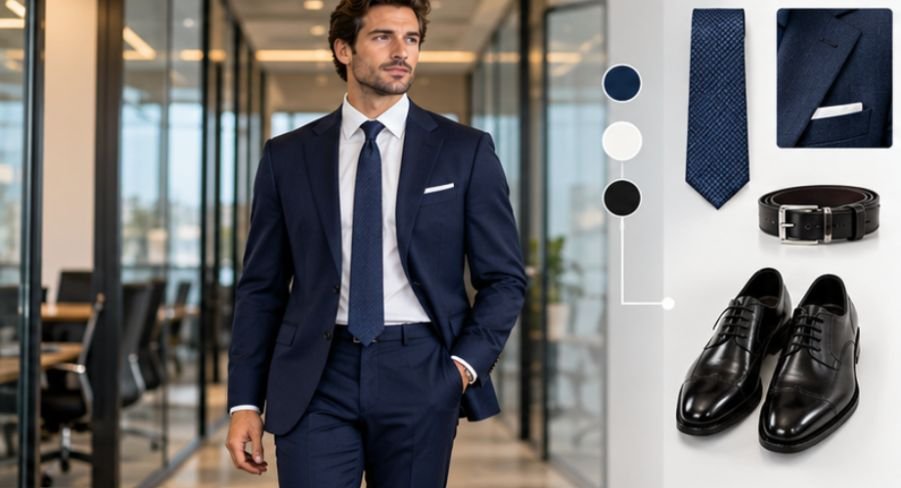
One of the worst combinations is a navy suit jacket with navy trousers that are almost—but not exactly—the same shade. Instead of looking coordinated, they usually look mismatched.
Create deliberate contrast. Navy with gray looks intentional. Charcoal with cream looks intentional. Two slightly different charcoals can look like an unsuccessful attempt to reconstruct a suit. The eye should recognize immediately that you chose separates.
Protect the Jacket if You Still Wear the Full Suit
There is another issue that often gets overlooked: uneven wear. Suppose you regularly wear the jacket with chinos but save the matching trousers for occasional formal events. Over several years, the jacket can experience more sunlight, friction, cleaning and general wear than the trousers.
Eventually, the two pieces may no longer match perfectly. That matters if it is an expensive suit you intend to keep as a complete set.
Follow the garment’s care label rather than assuming every wool jacket requires identical treatment. The Federal Trade Commission requires U.S. manufacturers and importers to provide supported care instructions for covered garments.
For your only interview suit or formal navy suit, I would preserve the matching set. An older flannel suit or casual linen suit provides much more freedom to experiment.
Frequently Asked Questions
1. Can you wear a suit jacket as a blazer with jeans?
Yes, if the jacket is textured, matte and softly constructed. Dark, clean denim works best. Avoid pairing jeans with shiny worsted wool, pinstripes or heavily structured business jackets.
2. Can I wear a navy suit jacket with khaki pants?
Often, yes. Navy and khaki create clear contrast. The combination works best when the jacket has a matte finish and relatively relaxed construction rather than a highly formal appearance.
3. Can I wear a black suit jacket as a separate?
Usually not. Smooth black suit jackets strongly signal formal suiting. A deliberately casual black jacket with texture, softer tailoring or distinctive details is easier to wear separately.
4. Is a suit jacket more formal than a blazer?
Generally, yes. Suit jackets are designed for coordinated trousers and frequently use smoother fabrics and more structured tailoring. Blazers and sport coats are intentionally designed to work with contrasting pants.
The Detail That Decides the Outfit
The surprising part about can you wear a suit jacket as a blazer is that color is rarely the deciding factor. Two navy jackets can behave completely differently: one may look natural with gray trousers, while the other instantly reveals itself as half of a corporate suit.
I would judge the fabric first, then the structure, pattern and contrast. If the jacket is matte, textured and relaxed enough to look complete by itself, use it. If it is sleek, striped, black or strongly structured, respect the original design and keep the suit together. The goal is not merely to separate two garments. It is to make the separation look deliberate.