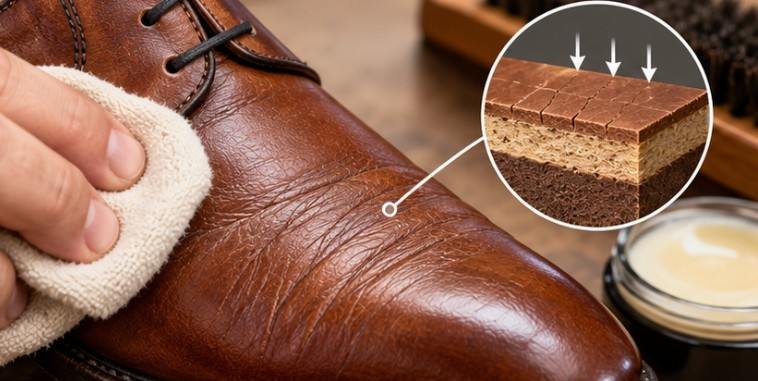
A crack in a leather shoe is not automatically a death sentence. The important question is whether you are looking at a damaged surface finish or leather fibers that have actually separated.
That distinction determines whether conditioning and cosmetic repair can help or whether the upper has lost the strength needed to survive normal walking. If you are wondering how to tell if leather shoes are too cracked to restore, inspect the depth, location, flexibility, and surrounding leather before spending money on restoration.
Leather is largely a collagen-based material. Once deterioration progresses far enough to destroy that supporting fiber network, no conditioner can reconnect it. Research cataloged by the Smithsonian Museum Conservation Institute shows that deterioration changes leather’s physical strength and collagen structure, while humidity and environmental conditions can accelerate those changes.
The Fastest Way to Judge a Cracked Leather Shoe
Start with one principle: shallow surface damage can often be improved; structural separation usually cannot.
Clean enough dirt or polish from the area to see the leather clearly, but do not saturate it. Then flex the shoe gently where it naturally bends. Watch the crack rather than the entire shoe.
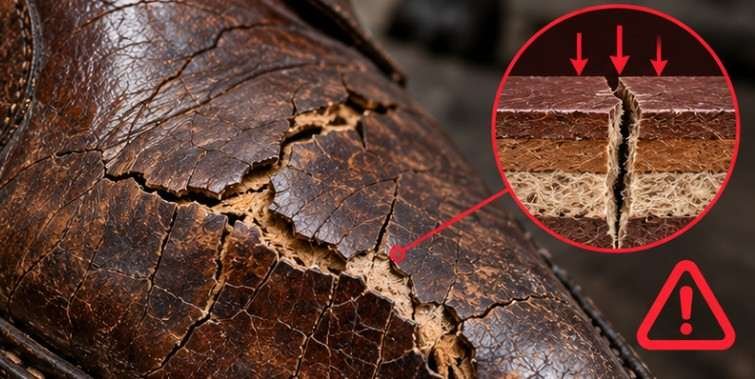
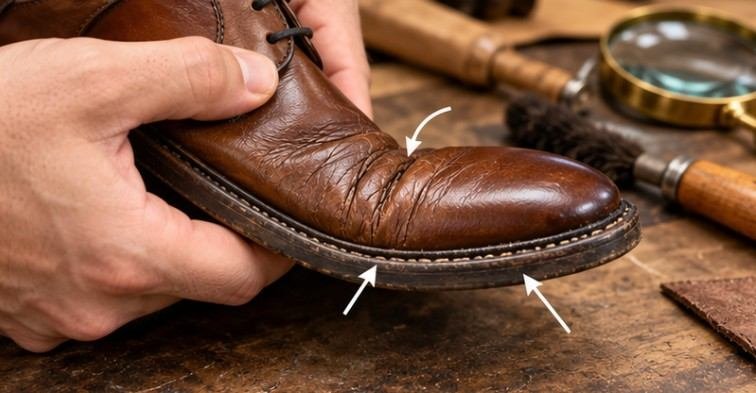
A shallow line that stays essentially closed is usually cosmetic deterioration. A crack that spreads into a visible opening, exposes a lighter fibrous layer, reveals lining material, or grows dramatically during flexing signals structural damage.
The location matters just as much as depth. A small defect near a relatively stationary quarter may remain usable for years. A similar crack running across the vamp—the area that repeatedly bends behind the toes—receives thousands of flexing cycles during wear.
Surface Cracking and Structural Failure Are Different Problems
Leather shoe restoration becomes easier to understand if damage is divided into three levels.
| Condition | What you will see | Likely outlook |
| Surface dryness or finish checking | Fine lines with no opening | Usually restorable |
| Shallow grain cracking | Visible cracks that remain closed during flexing | Often cosmetically repairable |
| Structural splitting | Crack opens, fibers separate, lining may show | Usually beyond lasting restoration |
This distinction also explains why photographs can be misleading when buying secondhand footwear online. Heavy polish may conceal deterioration, while creasing under harsh lighting can look much worse than it really is.
If an older pair is buried beneath layers of wax, dealing with old polish buildup on leather shoes first can reveal the true condition of the grain.
Four Tests I Would Use Before Attempting Restoration
1. Perform a Gentle Flex Test
Hold the shoe at the heel and forefoot and bend it only as much as ordinary walking would. Healthy leather should flex without the damaged area spreading dramatically. If the crack opens like a tiny cut, especially across the vamp, the fiber structure has already separated.
Do not repeatedly flex a fragile vintage shoe simply to test it. One controlled movement is enough.
2. Look Into the Crack
Use bright indirect light. A dark surface line is usually less concerning than a crack containing fuzzy, pale, or frayed material. Those visible fibers indicate that damage extends below the finish. If you can see the lining through the opening, you are no longer dealing with cosmetic cracking.
3. Check the Leather Around the Damage
One isolated crack surrounded by supple leather is different from an upper covered in brittle areas. Gently press the leather several inches away from the damaged spot. If additional tiny cracks immediately appear, the problem is widespread rather than localized.
Leather deterioration is not merely cosmetic. University of Illinois preservation guidance explains that environmental factors including heat, moisture, acidity, pollutants, and light can weaken collagen fibers until leather becomes brittle or powdery.
4. Inspect the Stitching and Welt Area
Damage near the sole can change the economics of the repair. Look where the upper meets the welt or sole. If leather has torn around stitching holes, become extremely thin, or pulled away from its attachment points, a cobbler may have little sound material available for anchoring repairs.
A high-quality welted shoe may justify significant work, but even excellent construction cannot compensate for an upper that is disintegrating.
When Cracked Leather Is Still Worth Saving
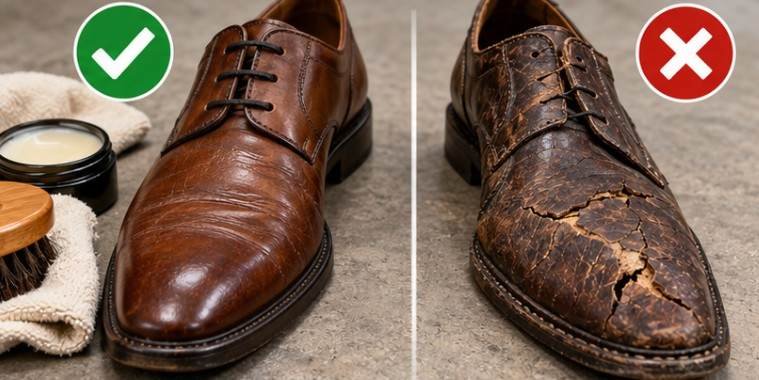
Fine creases, mild stiffness, small scratches, faded color, and superficial cracks do not necessarily make a shoe unusable.
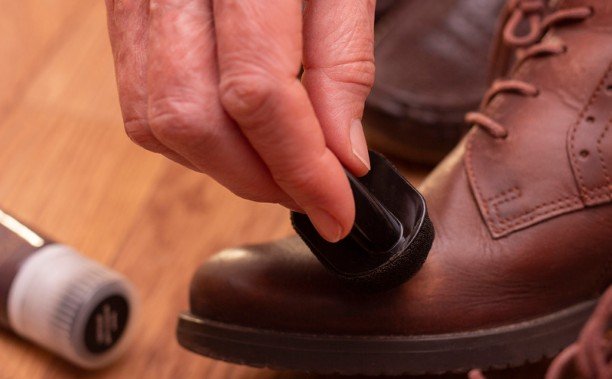
Cleaning followed by an appropriate leather conditioner or cream can restore some flexibility to dry but structurally intact leather. Shallow imperfections can sometimes be minimized with flexible filler, careful smoothing, recoloring, and polish.
The objective should be improvement rather than making old leather literally new again.
Be particularly cautious with heavily corrected or coated leather. Sometimes what appears to be “leather cracking” is primarily a pigmented surface coating separating from the material underneath. Cosmetic refinishing can improve its appearance, but peeling coatings are difficult to make permanently invisible.
When I Would Stop Trying to Restore the Shoes
The strongest warning sign is a full-depth crack across a flex point. I would also reject restoration when multiple cracks intersect, pieces of the upper are beginning to detach, the surface crumbles when rubbed, or leather surrounding important stitching has lost strength.
Powdery deterioration deserves particular caution. The Library of Congress notes that severely deteriorated leather can become brittle, cracked, and powdery and advises against assuming that leather dressings will reverse the damage.
The National Park Service reaches a similar conclusion about indiscriminate leather dressing. Its conservation guidance explains that oils, fats, waxes, and solvents may discolor leather, create sticky surfaces, interfere with later repair, or contribute to other deterioration problems. In other words, soaking badly cracked shoes with oil is not restoration.
Why Conditioner Cannot Heal a Deep Crack
Conditioners are often misunderstood because they can produce dramatic before-and-after photographs. They may lubricate leather, darken dry areas, improve suppleness, and make fine surface lines less noticeable. What they cannot do is fuse torn collagen fibers back together.
Conservation literature makes the same distinction. Conservation Online notes that leather dressings may improve flexibility to a limited extent but cannot reverse leather that has chemically decayed. That makes structural integrity—not shine—the standard that matters.
Research published through the University of Cincinnati’s Journal of the American Leather Chemists Association also shows that advanced deterioration is associated with disruption of collagen fiber networks and losses in mechanical strength and softness.
Consider Fit Before Paying for an Expensive Restoration
Even structurally repairable shoes may not deserve restoration if they fit badly.
Too much pressure across the instep or vamp increases flexing and stress exactly where aging leather is most vulnerable. Men who consistently experience that problem should consider footwear designed for a high instep and adequate Oxford shoe volume rather than forcing a tight vintage pair to work.
A cobbler can replace heels, soles, and some components. Changing the fundamental shape of an old leather upper is much harder.
Frequently Asked Questions
1. Can deeply cracked leather shoes be repaired?
A cobbler may stabilize or cosmetically disguise some damage, but full-depth splits generally cannot regain their original structural strength. Replacement of the affected leather may be necessary.
2. Does leather conditioner remove cracks?
No. Conditioner may soften dry leather and reduce the appearance of fine surface cracking, but it cannot reconnect fibers that have physically separated.
3. Are cracks across the shoe vamp serious?
Yes. The vamp repeatedly bends while walking, so structural cracks there experience continuous stress and are more likely to spread than cracks in relatively stationary areas.
4. Is flaking leather always genuine leather deterioration?
Not necessarily. Flaking can involve a pigmented or synthetic surface coating rather than the entire hide. Examine what lies beneath the peeling layer before deciding whether restoration is worthwhile.
The Final Call
Knowing how to tell if leather shoes are too cracked to restore ultimately comes down to looking beneath the shine. Fine creases, dry leather, faded color, and shallow grain cracks may still leave you with years of wear. Gaping splits, exposed inner layers, widespread brittleness, and torn stitching areas tell a different story.
I would spend restoration money only when the leather remains structurally sound after a gentle flex test. Conditioner can improve neglected leather, and a skilled cobbler can perform impressive repairs, but neither can rebuild fibers that have already broken apart. The best restoration decision is sometimes recognizing when the leather itself has reached its limit.