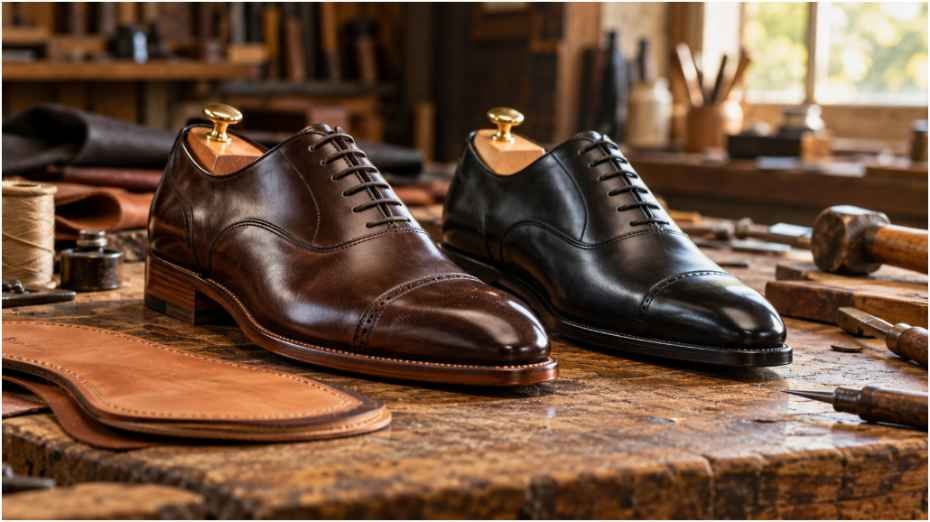
I sliced open a ten-year-old bespoke Oxford and a factory-assembled equivalent on my workbench to settle the debate for good. When you pit hand welted bespoke leather dress shoes vs factory made footwear, the difference is not just about immaculate stitch density or hand-burnished aniline patinas. The actual battle takes place inside the bottom assembly, well beneath the sock liner.
A high-end factory shoe looks strikingly sharp out of the box. Yet, the mechanical integrity holding it together differs fundamentally from an artisan’s hand-welted shoe.
Cross-Sectional Architecture
| Component | Hand-Welted Bespoke | Factory Goodyear-Welted |
| Insole | 6–8 mm solid leather | 2.5–3.5 mm thin leather or fiberboard |
| Welt attachment structure | Carved leather holdfast channel; no glue | Glued canvas rib, or “gemming”; potential adhesive failure point |
| Inseam stitching | Awl-pierced hand stitches connecting the holdfast, upper, and welt | Machine chain stitch connecting the upper and welt to the canvas rib |
| Cavity filling | Flat leather skiving or compressed natural cork plate, 1–2 mm | Hot granulated cork paste mixed with glue, filling a 4–6 mm void |
| Outsole | Oak-bark-tanned leather sole hand-stitched to the welt | Outsole machine rapid-stitched to the welt |
The Internal Architecture: Carved Holdfast vs. Canvas Gemming
The primary structural joint of any welted shoe anchors the upper, the insole, and the welt strip. How a shoemaker joins these three components dictates whether the shoe lasts five years or fifty.
Carving the Holdfast from Solid Oak Bark Insole
In true hand-welted bespoke cordwaining, the artisan starts with a vegetable-tanned leather insole roughly 5 mm to 8 mm thick, often sourced from historic tanneries like J. & F.J. Baker & Co..
The shoemaker tempers the leather in water, blocks it to the wooden last, and uses a feathering knife to carve a continuous structural ridge—known as the holdfast—out of the leather itself.
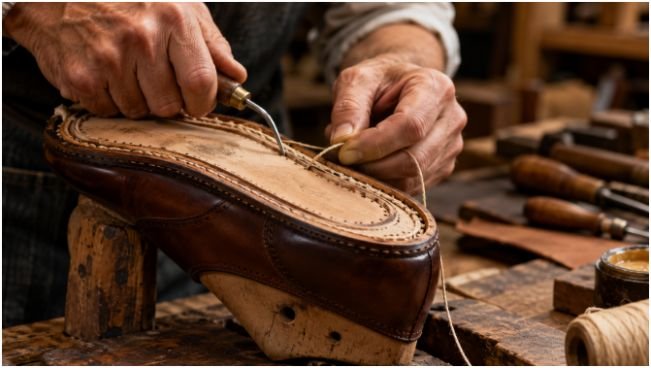
Using a curved hand awl, the cordwainer pierces horizontally through this carved leather ridge, the shoe upper, the lining, and the welt. They pull waxed boar-bristle threads through the channel by hand, tensioning every single stitch individually. There is no artificial wall, no synthetic strip, and zero glue along this mechanical axis.
How Factory Goodyear Gemming Introduces a Hidden Glue Line
Factory-made shoes cannot run a machine needle through a horizontal carved ridge in a curved leather bed. To automate production, standard goodyear welted machines rely on an intermediary: gemming.
Factories take a thinner insole (around 2.5 mm to 3 mm) and paste a raised canvas rib onto its bottom using industrial contact cement. A curved needle Goodyear welting machine then chain-stitches the upper and welt to that canvas flap.
While efficient, this introduces a single point of failure. The entire structural connection between your upper and your sole rests on a band of adhesive. If you expose the shoe to deep puddles, heavy humidity, or seasonal heat, that glue line slowly degrades.
When the canvas gemming peels away from the insole, the welt loses tension, and the shoe undergoes internal delamination.
Footbed Cavity Fillers: Solid Leather Skivings vs. Granulated Cork Paste
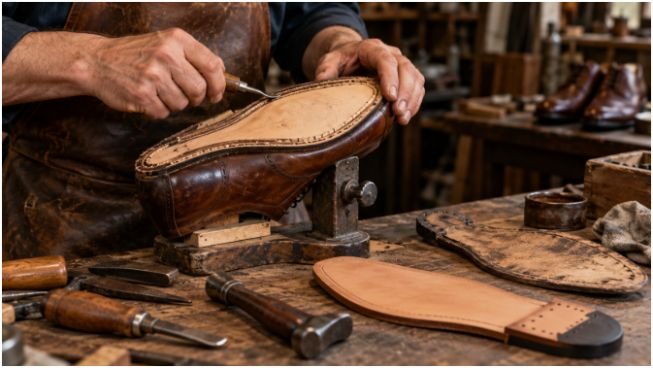
Beneath the insole sits a structural cavity. The depth of that cavity depends directly on how the shoe was welted.
Because a canvas gemming rib stands 4 mm to 6 mm tall, factory shoes create an empty chasm beneath the foot. Factories fill this void with a paste made of hot granulated cork mixed with synthetic resins and binders.
When you first wear the shoe, this paste feels plush. Over two or three years of walking, however, dynamic foot pressure displaces the granulated cork. It shifts, lumps, and migrates toward the outer edges of the ball joint, leaving hollow impressions beneath high-load areas.
A hand-carved holdfast stands only 2 mm proud of the insole. The resulting cavity is shallow and uniform. In bespoke workshops, makers fill this minuscule space with trimmed sheets of dense vegetable-tanned leather skivings or a flat, pure cork sheet.
Instead of collapsing into pockets, the footbed remains mechanically level while the thick, solid leather insole molds gradually to your plantar profile.
According to clinical standards established by the American Podiatric Medical Association (APMA), sustained anatomical arch support depends on this structural stability beneath the metatarsal heads rather than a rapidly collapsing filler layer.
Heel Counters and Toe Puffs: Hand-Skived Veg-Tan vs. Heat-Molded Celastic
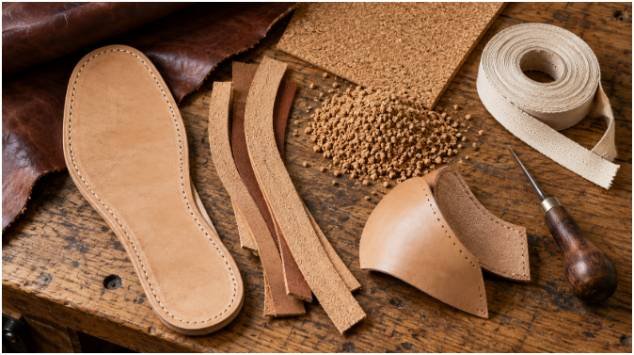
Heel counters lock your calcaneus in place, preventing heel slip and internal chafing. Toe puffs keep the toe cap rigid and protect the shape from collapsing when bumped.
- Bespoke construction: Artisans cut counters and toe puffs from genuine vegetable-tanned shoulder leather. They skive the perimeter paper-thin by hand, wet the leather with wheat paste or starch, and mold it directly over the last. Over weeks of wear, body heat and natural moisture cause that leather counter to conform specifically to the contours of your Achilles tendon and heel bone. If crushed in luggage, a cobbler can steam, reshape, and re-last it without damage.
- Factory ready-to-wear: Standard factories rely on thermoplastic sheets or celastic—a fabric impregnated with heat-activated resin. A worker slides the synthetic sheet between the upper and lining, places the shoe into a heated clamping press for 15 seconds, and chills it. It sets instantly like plastic. However, once a plastic counter fractures or develops a sharp kink, it cannot be reshaped. It will bite into your heel until you throw the shoe away.
Wear Longevity and the Infinite Resole Test
Resoling Capacity Comparison
| Shoe Construction | Claimed Resoling Capacity | Explanation Provided |
| Hand-Welted Bespoke | 10+ resolings | Cobbler traces the original awl holes in the carved leather holdfast. |
| Factory Goodyear-Welted | 3–5 resolings | Machine needles may damage the canvas gemming rib during repeated repairs. |
| Factory Cemented | 0–1 resolings | Removing the sole may tear the lasting margins and leather fibers. |
When a bespoke shoe needs a new outsole, a skilled artisan cuts the external sole stitching without touching the welt seam. The carved holdfast remains entirely intact.
The cobbler guides their awl through the original holes punched into the leather foundation decades prior. Because no machine punches fresh perforations, a pair can be resoled ten or twelve times over forty years without compromising the foundation.
With a factory Goodyear shoe, a rapid stitcher punches through the welt and outsole at high speed. After three or four resoling cycles, those dense machine needle strikes perforate the canvas gemming like a sheet of postage stamps.
Eventually, the canvas tears away, necessitating an expensive rebuild that few commercial repair shops can perform. If you opt for rugged, heavy double leather sole dress shoes, the high torque placed on a glued gemming rib accelerates that mechanical separation even faster.
The Fit Geometry: Wooden Last Sculpting vs. Generic Factory Volume
A factory-made dress shoe is built over an injection-molded plastic last designed to fit a standard statistical median. If a manufacturer builds on an 8.5D last, they engineer it to fit as many average feet as possible.
The factory last assumes your left and right feet are identical. It assumes your navicular bone height matches an industry average and that your lateral arch drop follows a symmetrical bell curve.
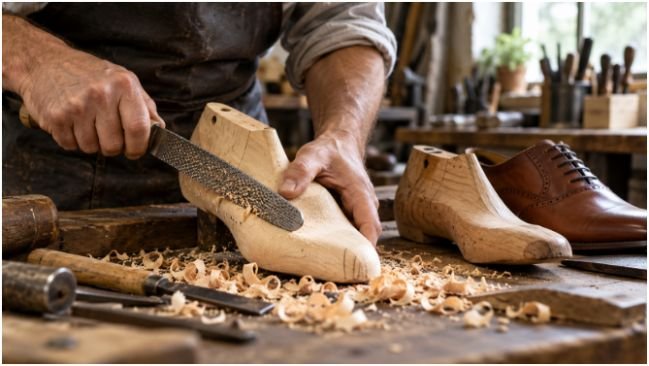
Bespoke shoemakers begin with raw blocks of beech, hornbeam, or maple wood. They measure over thirty distinct metrics per foot: ball girth, instep girth, heel-to-ball ratio, and dorsal variance. They hand-rasp the wood to account for a lower right instep, a prominent bunion on the left big toe, or a narrow heel cup.
The guild traditions preserved by The Cordwainers Company highlight this balance between anatomy and leather dynamics: the leather is pulled and tensioned across the custom wood grain over several weeks. This extended resting time allows the collagen matrix within the leather to stabilize, ensuring the finished shoe never fights your skeletal frame.
The Financial Reality: Cost-Per-Wear Over Thirty Years
Bespoke footwear demands a significant upfront investment, typically ranging from $3,000 to over $7,000 depending on the workshop. A top-tier factory Goodyear shoe costs between $400 and $900.
| Financial & Structural Metric | Factory Cemented | High-Grade Factory Goodyear | Hand-Welted Bespoke |
| Initial Investment | $150 – $250 | $450 – $800 | $3,500 – $6,000 |
| Expected Lifespan | 1 – 3 Years | 5 – 10 Years | 25 – 40+ Years |
| Maximum Clean Resolings | 0 – 1 | 3 – 5 | 10 – 15+ |
| Internal Mechanical Joint | Direct Glue Film | Glued Canvas Rib (Gemming) | Carved Leather Holdfast |
| Heel Stiffener Composition | Synthetic Plastic / Board | Celastic / Thermoplastic | Skived Vegetable-Tanned Leather |
| Estimated Cost Per Wear (Decade) | ~$0.55 / wear (frequent rebuys) | ~$0.25 / wear | ~$0.18 / wear |
If your feet conform well to standard sizing and you maintain a rotation of three or four pairs, premium factory shoes offer outstanding functional value.
However, if you have asymmetrical arches or persistent fit friction, buying multiple pairs of high-end factory shoes that never truly fit proves far more expensive than commissioning one pair of bespoke shoes that supports your biomechanics for life.
The Final Verdict: Don’t Get Fooled by the Surface Polish
Do not let mirror-shined toes and painted channel soles seduce you into paying bespoke-level prices for factory-line shortcuts. If a brand charges you upwards of $1,500 for a dress shoe, demand complete transparency on what lies between the welt and the insole.
If they cannot show you a hand-carved holdfast and genuine leather counters, you are paying for brand prestige, not master-level cordwaining. Inspect your current lineup, feel inside the heel counter for plastic rigidity, and invest where structural honesty actually lives.
Frequently Asked Questions
1. Can you convert a factory Goodyear-welted shoe into a hand-welted shoe during a rebuild?
No, because factory insoles are too thin to carve a holdfast, requiring the cobbler to replace the entire bottom assembly with fresh, thick leather.
2. Why do luxury factory brands continue using glued gemming instead of carving leather?
Carving a holdfast and sewing a welt by hand takes roughly 15 to 20 hours of manual labor per pair, making automation impossible.
3.How can I verify whether a shoe has a real leather counter without cutting it open?
Pinch the top rim of the heel counter firmly; real leather flexes stiffly with a slight fibrous give, while synthetic celastic feels hard and snaps under heavy pressure.
4. Does a hand-welted shoe take longer to break in than a Goodyear-welted shoe?
Hand-welted shoes break in faster because the solid leather insole bends naturally without the stiff glue layers found in canvas gemming.