
A loafer is technically a slip-on, yet the right pair can look completely at home beneath a sharply tailored suit. The important distinction is not whether the shoe has laces. It is whether its shape, leather, color, and level of formality make sense with the tailoring above it.
So, can you wear loafers with a suit? Absolutely. Sleek penny, tassel, and horsebit loafers can work for offices, weddings, dinners, cocktail events, and many modern professional settings. The combination only starts to fail when the shoe looks significantly more casual than the suit. That makes proportion and context more important than any old-fashioned rule about slip-ons.
Why Loafers and Suits Can Work Together
Traditional business dressing usually places Oxford shoes near the formal end of the footwear spectrum. Loafers sit slightly lower because they lack laces and originally carried stronger leisure associations. That distinction still matters, but workplace clothing has become more flexible.
Georgia Tech’s Career Center, for example, lists loafers among business-casual footwear while reserving broader “dress shoes” for business-professional attire. Georgia Tech professional attire guidance Other institutions are more permissive: the University of Illinois includes loafers among footwear options for business-professional dress.
The disagreement tells us something useful: loafers exist on a spectrum.
A polished black calfskin penny loafer with a thin sole is much closer to an Oxford than a tan suede driving loafer with rubber nubs. Simply calling both shoes “loafers” ignores the characteristics that determine their formality.
The Three-Second Loafer-and-Suit Test
Before leaving the house, judge the outfit using three factors: silhouette, surface, and setting.
1. Look at the Silhouette
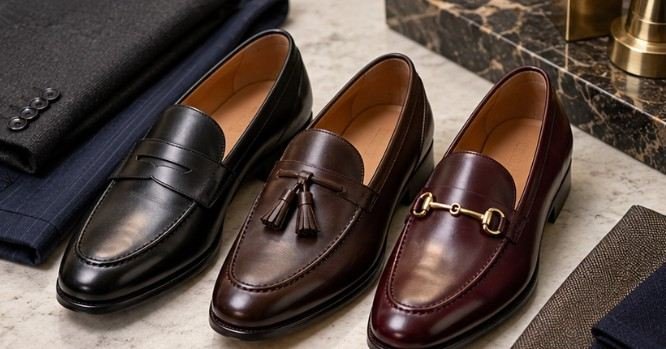
A dress loafer should appear relatively slim when viewed from above and from the side. Look for a moderately tapered or rounded toe, a close-fitting heel, a low-profile sole, and restrained decoration. Penny loafers, refined tassel loafers, and simple horsebit loafers are usually the safest options.
Heavy lug soles, exaggerated square toes, oversized hardware, contrast stitching, and bulky moccasin shapes create more visual weight. They may look excellent with casual trousers but can overpower clean suit tailoring.
2. Check the Surface
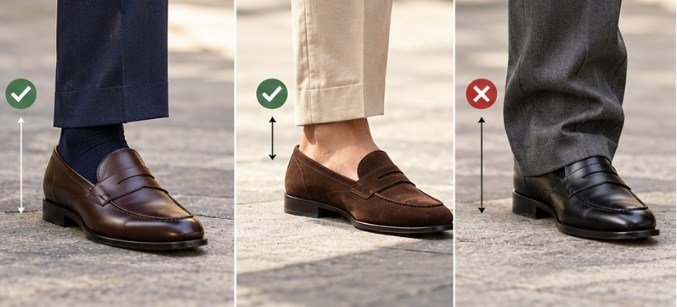
Smooth leather raises formality. Suede lowers it.
That does not make suede unsuitable. A tobacco suede loafer can look exceptional with an unstructured beige linen suit at an outdoor summer wedding. The same shoe underneath a conservative charcoal worsted-wool suit at an important financial-services interview may appear noticeably underdressed.
Western Michigan University’s interview guidance makes a similar distinction, describing dress loafers as appropriate professional footwear while excluding casual loafers and boat shoes from Western Michigan University interview attire guide.
3. Consider the Setting
Ask one question: would being slightly underdressed matter here?
If the answer is yes, choose the more conservative shoe.
Texas A&M’s Career Center recommends conservative professional dress for interviews dress-for-success guidance and specifically separates dark professional shoes from more casual footwear such as loafers in its business-casual guidance.
For a regular office day, restaurant dinner, summer wedding, or cocktail reception, you usually have considerably more freedom.
Best Loafers to Wear With Different Suits
| Suit | Safest Loafer Choice | Best Setting |
| Navy | Dark brown, oxblood, or black leather | Office, wedding, dinner |
| Charcoal | Black or dark oxblood leather | Business, evening events |
| Medium gray | Black, brown, or burgundy | Office, social events |
| Beige or tan | Medium brown leather or suede | Summer weddings, daytime events |
| Light blue | Brown or tan loafer | Warm-weather occasions |
| Black | Sleek black leather | Evening or dressier events |
These combinations work because the shoe does not compete with the suit. Black loafers create the strongest visual formality. Dark brown feels slightly softer and works particularly well with navy. Burgundy or oxblood provides controlled contrast without becoming flashy. Tan loafers are better reserved for lighter suits and daytime outfits.
Penny, Tassel, or Horsebit: Which Looks Dressiest?
There is no absolute winner because construction matters, but certain designs are easier to style.
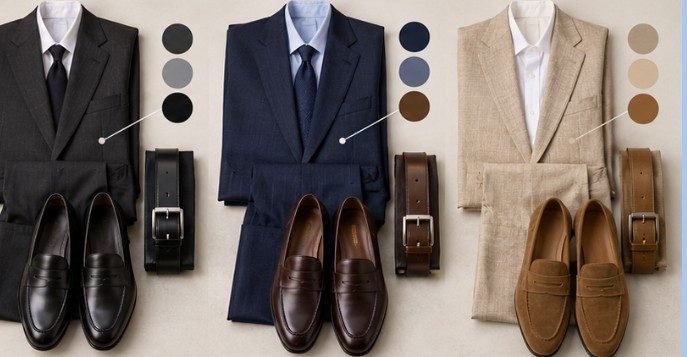
Penny Loafers Are the Safest All-Rounders
A plain leather penny loafer is probably the easiest entry point if you intend to wear loafers with tailoring regularly.
Its decoration is minimal, so it works with both structured business suits and softer casual tailoring.
Tassel Loafers Add More Personality
Tassel loafers have long been associated with polished American menswear. They can work particularly well with navy, gray, or textured suits when the shoe remains sleek.
Avoid versions with extremely bulky tassels or heavy soles if the rest of the outfit is conservative.
Horsebit Loafers Feel Slightly More Expressive
The metal bar across a horsebit loafer naturally attracts attention.
That makes the style effective for weddings, dinners, cocktail events, and creative offices. With conservative corporate clothing, choose understated hardware rather than a large, highly polished ornament.
Loafers are hardly a recent menswear invention. The Metropolitan Museum of Art’s Costume Institute preserves Italian leather loafers dating from 1970–1989, while historical accounts trace modern penny-loafer culture much further back.
Trouser Length Can Make or Break the Outfit
Loafers expose more of the foot than lace-up shoes, which means excessive fabric around the ankle becomes especially obvious.
Aim for trousers with a clean hem and little to moderate break. A modern tapered suit may have virtually no break, while a traditionally cut suit can comfortably have a slight one.
Avoid trousers that collapse into several folds over the vamp.
The goal is not necessarily to expose your ankle. It is to let the trouser fall cleanly enough that the loafer remains visible and the leg line stays uninterrupted.
Should You Wear Socks?
For professional environments, wear dress socks.
A simple rule is to coordinate the socks primarily with the trousers rather than trying to match the shoes exactly. Navy trousers with dark navy socks, for instance, visually extend the leg.
Southern Utah University’s professional dress guide recommends conservative socks close to the color of the suit or shoes and explicitly includes conservative loafers within business-professional menswear.
No-show socks are better for relaxed summer tailoring, destination weddings, outdoor events, and deliberately casual suits. Actual bare feet are less practical because perspiration goes directly into the shoe lining.
When Loafers Are the Wrong Choice
The answer to can you wear loafers with a suit changes when the dress code becomes highly ceremonial or extremely conservative.
For black tie, a traditional tuxedo normally calls for formal evening footwear rather than an everyday penny or tassel loafer. Highly polished formal pumps and appropriate lace-ups remain safer choices.
Conservative job interviews are another situation where an Oxford may eliminate unnecessary uncertainty.
Be equally careful with severe pinstripe suits, traditional three-piece business suits, and other tailoring that communicates strong formality. A relaxed suede loafer underneath can create an obvious mismatch.
The easiest rule is simple: the more serious the suit looks, the quieter and dressier the loafer should become.
Frequently Asked Questions
1. Can you wear loafers with a suit to a wedding?
Yes. Leather or suede loafers work particularly well for semi-formal, daytime, outdoor, and summer weddings. Choose sleek black leather for dressier evening celebrations.
2. Can I wear brown loafers with a navy suit?
Yes. Dark brown is one of the most versatile choices for navy tailoring. Medium brown works better when the occasion is less formal or the suit fabric is lighter.
3. Are penny loafers formal enough for business suits?
Sleek leather penny loafers can work with many business suits. For highly conservative interviews, legal settings, or traditional corporate environments, lace-up Oxfords remain the safer option.
4. Can you wear loafers without socks with a suit?
You can use hidden no-show socks with lightweight summer tailoring. Visible bare ankles are generally better suited to relaxed social events than conservative professional environments.
The Final Measure Is Visual Consistency
The most successful suit-and-loafer combinations do not look as though someone deliberately broke a footwear rule. They simply look balanced.
I would start with a smooth dark-brown or black leather penny loafer, pair it with navy or gray tailoring, and keep the trousers cleanly hemmed. That combination is difficult to get wrong.
From there, suede, tassels, horsebits, lighter colors, and sockless styling can gradually make the outfit more relaxed. The question is therefore not simply whether loafers belong with suits. It is whether your particular loafers speak the same formal language as your particular suit.