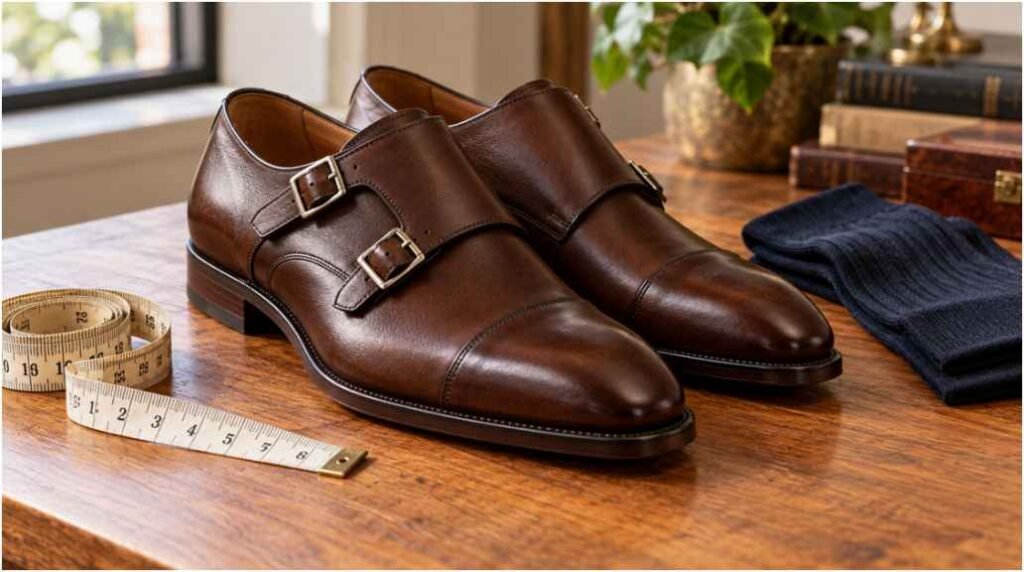
A loose oxford can be rescued by yanking the laces tighter, but an ill-fitting monk strap leaves zero room for forgiveness. Finding the right pair demands that you measure interior volume and instep girth rather than relying on standard sneaker sizes.
This double monk strap leather dress shoes sizing guide provides the exact framework I developed after evaluating dozens of pairs and learning the hard way that fixed strap geometry behaves completely differently from open or closed lacing systems.
The Mechanics of Sizing Buckles Instead of Laces
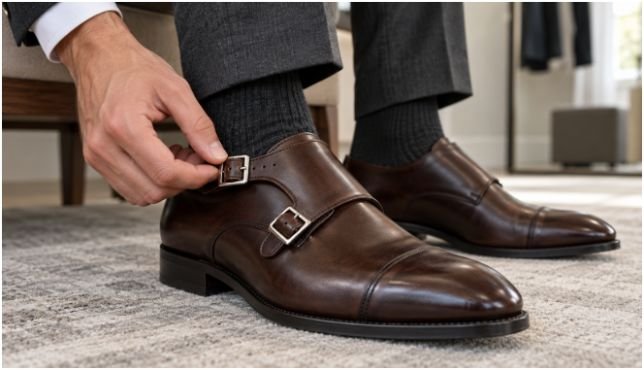
Double monk straps rely on two fixed anchor points across your vamp. Unlike bluchers or balmorals, you cannot selectively tighten the throat while leaving the lower bridge loose. The dual buckles compress your foot at a fixed downward angle directly across the navicular and cuneiform bones.
When you slip into full grain leather dress shoes, the upper will soften and mold around your foot over weeks of wear, but it will never increase in length. Leather yields slightly across lateral stress points, yet the strap length remains static. If the shoe’s throat volume is incorrect on day one, adjusting the buckles will either pinch your nerve pathways or leave your heel slipping out of the back.
The Instep Notch Rule
The middle hole on each strap exists for a functional reason. When you fasten a new pair out of the box, the prong must seat securely into the center aperture.
If you must cinch down to the tightest hole to prevent your foot from sliding forward, the last carries far too much vertical volume. Conversely, if you are forced onto the widest hole just to close the buckle, the vamp is too shallow. You need that outer hole reserved for days when natural swelling sets in.
Breaking Down Shoe Lasts and Volume
Shoe lasts define the three-dimensional interior space of your footwear. Most European and American heritage makers design their double monks on dedicated lasts that feature a lower instep cone to prevent excessive forward motion.
According to clinical observations documented by the Mayo Clinic, adult feet swell by up to half a shoe size by late afternoon as gravity and activity pool fluid in the lower extremities. Testing a pair on a low-volume last at 9:00 AM almost guarantees painful constriction by 5:00 PM.
How to Trace and Measure Your Feet at Home
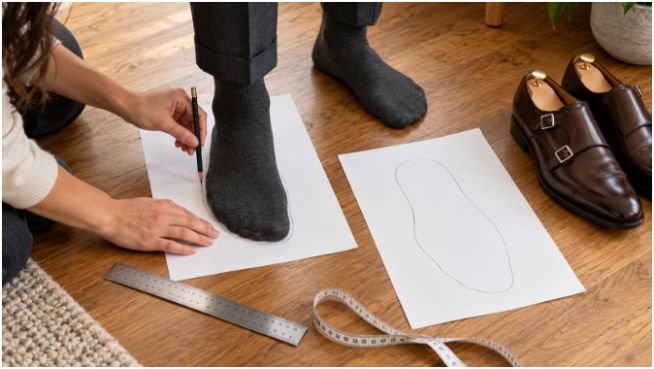
Never rely on the size label stamped inside your running sneakers. Athletic shoes use thick foam padding and curved footbeds that distort true dimensional requirements. Dress footwear requires raw, uncompressed millimeters.
Step-by-Step Tracing Technique
Wait until late afternoon, grab a sheet of blank paper, and locate a hard tile or wood floor. Tape the corners down securely.
- Put on the specific dress socks you plan to wear with your double monks.
- Step onto the paper, distributing your full body weight equally across both legs.
- Keep your pencil perfectly vertical at a 90-degree angle to the paper surface.
- Trace smoothly around your heel, along the lateral edge, around each toe, and through the medial arch.
- Repeat the exact process for your other foot on a second sheet.
Tilting the pencil inward cuts off several millimeters of width. Tilting it outward artificially balloons the outline.
Calculating Ball Girth and Length Offsets
Step off the outline and grab a rigid ruler. Draw a horizontal line flush against the back of your heel and another tangent to the tip of your longest toe. Measure the vertical gap between these lines in millimeters.
Subtract 4 millimeters from your final number to negate the thickness of your pencil lead.
Next, measure the widest distance across the ball of the foot, connecting the first and fifth metatarsophalangeal joints. For readers searching for leather dress shoes for wide feet, you must also measure ball girth.
Wrap a flexible tailor’s tape completely around those same joint knuckles while standing. Compare this girth reading directly against standard width sizing charts (D, E, or EE) provided by shoemakers like Crockett & Jones to avoid pinching the outer edge of your small toe.
The 5-Point Sizing Checklist on Foot
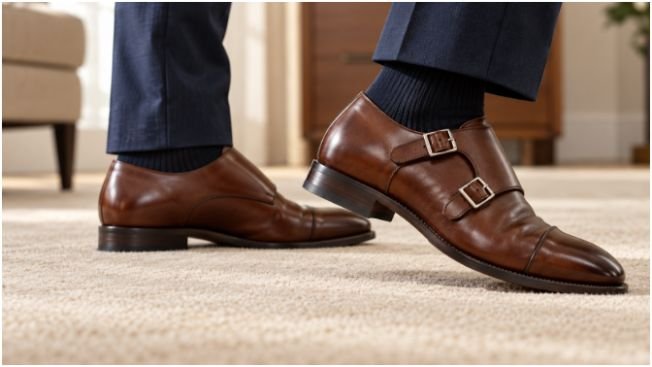
Once the shoes arrive at your door, conduct this rigorous fit test on a clean, carpeted surface:
Metatarsal Flexion and Toe Box Clearance
Stand upright and take several slow strides. As your foot rolls forward into the toe-off phase, observe where the leather creases across the vamp.
The primary crease should run straight across the ball of your foot, parallel to the lower strap. If the crease pinches sharply downward into your big toe joint, the shoe is either too long or the instep is too loose, causing excess leather to collapse inward. Maintain a clearance of roughly 0.5 inches (the width of your thumb) between your longest toe and the front tip of the shoe.
Preventing Heel Lift Without Overtightening
Goodyear-welted soles are inherently stiff when brand new because the thick leather outsoles, cork filling, and insole ribbing have not yet broken in. This stiffness naturally resists flexing, which creates slight heel lift on your first few steps.
You must distinguish between normal sole stiffness and a mismatched heel cup. Secure both straps on the center holes. If your heel lifts more than a quarter-inch, or if your foot slides forward until your toes bump the front, the heel counter is cut too wide for your calcaneus bone. Cinching the top strap beyond its natural resting point to fix heel slip will only cause the leather to dig into the front of your ankle.
Brand Benchmarks and Last Comparisons
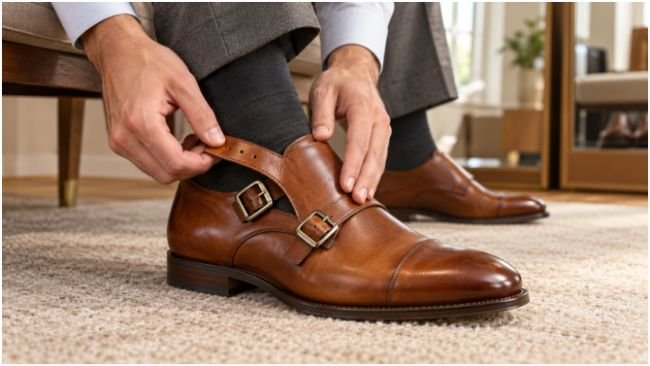
Different shoemakers shape their double monk straps with distinct internal geometries:
- Churchill & Company: Built with practical urban wear in mind. They incorporate hidden elastic tabs beneath the buckle hardware, providing subtle lateral stretch that accommodates medium to high arches without requiring custom last modifications.
- Fellmonger: Built using Blake-stitch construction on refined European profiles. They offer custom sizing paths where you submit barefoot tracing metrics and instep circumferences directly to their cordwainers, ensuring a glove-like fit across non-standard insteps.
- dmodot: Crafted on structured Italian-inspired lasts utilizing full-grain crust leathers and sheepskin footbeds. Their shoes run true to Continental EU sizing metrics, making them ideal if you regularly convert between UK, US, and EU footwear standards.
The Sprezzatura Solution for High Arches
Men with unusually high arches often experience localized throbbing beneath the top buckle of a double monk strap. When the lower strap fits the forefoot securely but the upper strap cannot reach the middle hole without intense pressure, you have two mechanical options.
First, an experienced cobbler can easily pierce an extra hole into the strap leather, spaced precisely 5 millimeters apart.
Second, you can adopt the classic Italian sprezzatura technique: leave the top buckle completely unfastened. The lower strap keeps the shoe anchored securely across your metatarsals, while the unfastened upper strap eliminates downward pressure on your ankle collar, granting instant comfort while delivering an effortless, relaxed sartorial aesthetic.
Frequently Asked Questions About Double Monk Strap Sizing
1. Do double monk strap shoes run true to sneaker size?
No, high-end leather dress shoes run a half size larger than standard athletic sneakers.
2. Will tight leather double monk strap shoes stretch out over time?
They yield roughly 1 to 2 millimeters in width across the ball, but they will never stretch in length.
3. Which strap hole should I use when trying on new double monks?
Fasten both buckles into the middle hole to leave room for future adjustments.
4. How much heel slip is acceptable during the initial break-in?
Up to an eighth of an inch is normal for stiff leather soles; anything more indicates a heel cup that is too large.
Buckle Up: Your Next Steps
Stop guessing your dress shoe size based on worn-out athletic footwear. Pull out your paper and tape, measure your foot length and ball girth this evening, and match those raw metrics to your maker’s specific last. Once your numbers are dialed in, lace-free style and all-day comfort will take care of themselves.